






























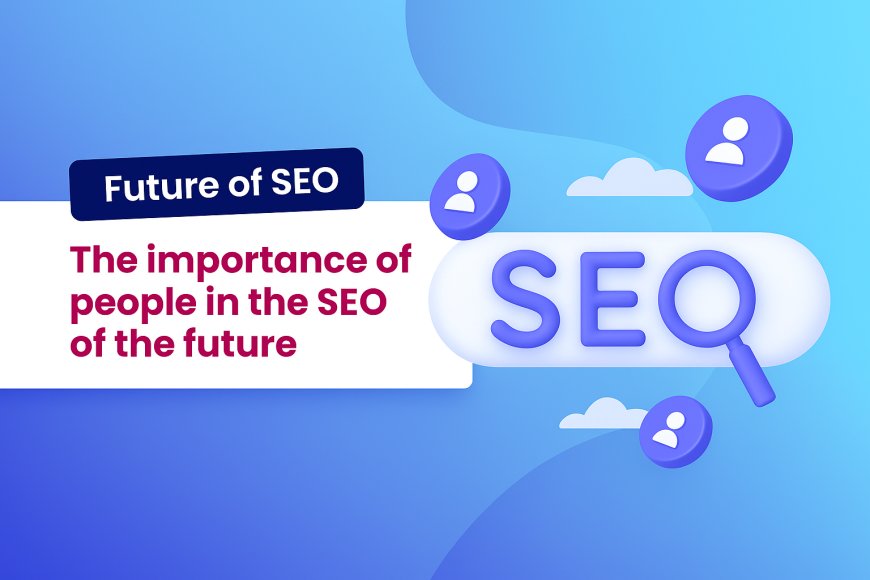
The importance Of People in the SEO Of the Future
However, this advancement poses a critical challenge: How can we differentiate truthful content from mere machine-generated "noise"?

We are experiencing a technological turning point. Artificial intelligence (AI) is no longer a futuristic tool: it's a reality that generates texts, images, videos, and strategies in seconds. However, this advancement poses a critical challenge: How can we differentiate truthful content from mere machine-generated "noise"?
A study conducted by Link Affinity reveals that traditional search engines like Google and emerging ones like SearchGPT are redefining their algorithms to prioritize authenticity, experience, and human expertise in content. In a world flooded with automated information, credibility has become the new Holy Grail of SEO.
The AI paradox: The more automation, the more value humans gain
Search engines are no longer satisfied with well-structured texts. They now demand clear signs of veracity. And this is where the EEAT concept comes into play:
-
Experience (demonstrable professional).
-
Expertise (specialized knowledge).
-
Authority (recognition in the field).
-
Reliability (transparency and verifiable sources).
Important Note: Explore top local business directories to boost your online visibility. Get listed today and connect with more local customers near you!
Although the concept of EEAT has been popularized by Google, new search engines that use AI to answer user queries also value expert support. Furthermore, the Link Affinity study shows that 48.2% of the sources displayed by SearchGPT in its results for health-related queries are endorsed by specialists, compared to 34.9% on Google for these same types of queries. Furthermore, in general media, SearchGPT displays 50.4% of articles with experts, compared to 29.8% on Google.
Furthermore, the study shows that in Google's own results, as you get closer to the Top 3, the search engine also places more emphasis on content endorsed by specialists. In Google's Top 10, content endorsed by specialists stands at 34.9% . This figure rises to 40.94% in the Top 5 and reaches 46.07% in the Top 3.
SEO strategies to succeed in the AI ??age
-
Sign your content with experts: If you don't have specialists in that field within your project, find experts to collaborate on your content by providing data, writing their opinions, or whatever you consider appropriate. This will make your information more credible, not only for search engines but also for your users.
-
Make transparency your differentiating value: Includes detailed biographies of authors , highlighting their training and achievements. Link to reliable sources (scientific studies, institutions, etc.) to reinforce trustworthiness. Don't be afraid to link. The idea that authority or PageRank is lost is an urban legend from the past.
-
Structure your content: Make your content easy to read and well-structured. This will make it easier for search engine crawlers.
-
Focus on providing value to your users, not to search engines: Positioning should be a side effect of a good brand reputation and credibility.
Conclusion
AI will be able to replace any SEO that simply creates optimized tags and filler text. What it can't do is replace the value of human experience or a person's critical judgment . Both traditional and new search engines know that returning unsubstantiated answers can render them useless, which is why they are working to return reliable sources for humans. As SEOs, we should view this as an opportunity, not a threat.